People using phones
For about twenty years I've been photographing people using phones. The set on Flickr has 1,884 photographs, taken between 2005 and late 2015. A smaller continuation lives on disk and in a 2024 video work called Blueface. I never set out to make a project of it. I kept finding the picture I'd taken yesterday in front of me again today, another head bent over another small lit rectangle, and I kept lifting the camera.
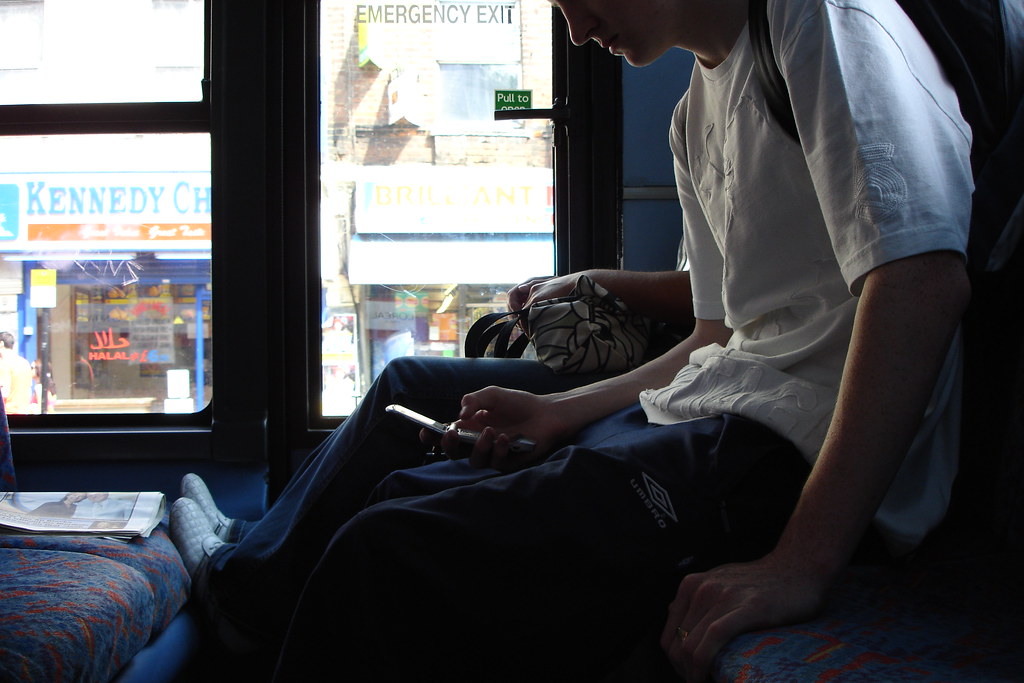
The titles are almost all timestamps. 29 November, 22.30. 18.15, London. 04 December, 16.36. No captions, no commentary. The working method has been the same since the Inkblots set in 2002. A small camera held at chest height, the screen as the frame, the photograph made quickly and the moment moved past. The pictures are taken from across a bus aisle, from the next café table, from the queue behind. People are absorbed; they don't notice. That absorption is the subject.
Cool light in warm rooms
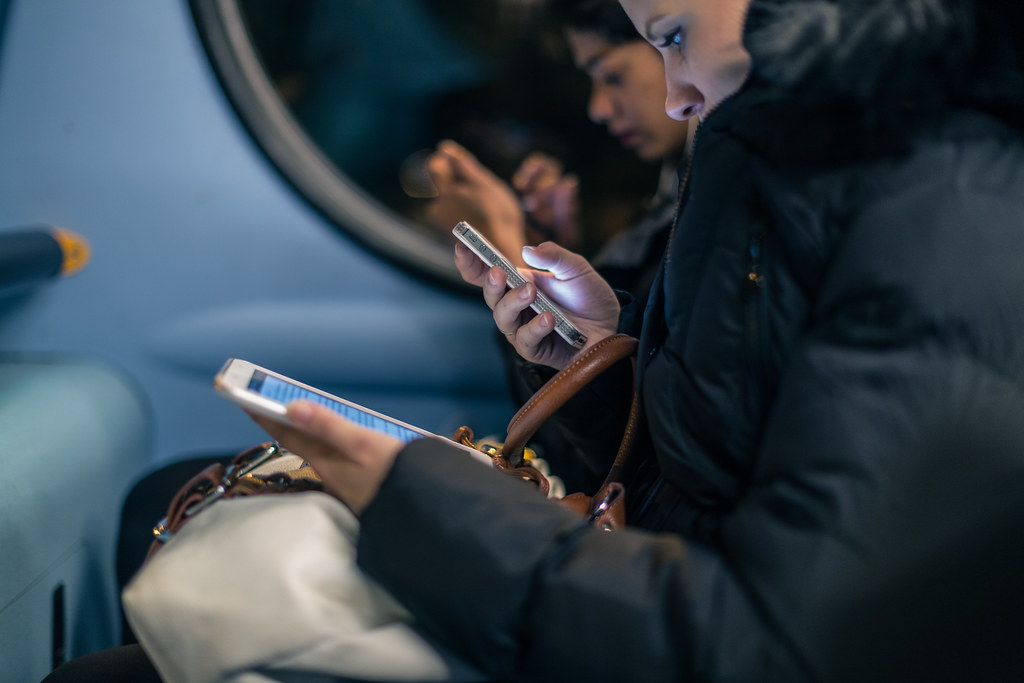
The most consistent thing across the archive, which I didn't notice for years, is that the phone screen is almost always the coolest light in the picture. A warm tungsten pub. A sodium-orange domestic interior. The green-grey fluorescents of a London Tube concourse. The ambient amber of a ferry waiting hall. The phone, in every one of these, glows blue or white. Smaller than the room around it, but more attended-to. A great deal of this album is the warm room and the cold rectangle.
Device evolution as social evolution
Because the archive is long, you can read the history of mobile devices off it almost year by year. The 2005 to 2008 photographs are nearly all of phones held up as objects. A Nokia 6680 with an antenna. A hand presenting an SMS to the camera. A green LG candybar with a fold-out television antenna pressed against a Korean coach window for digital radio. A flip phone with a glowing keypad on a bar table beside an empty water glass. People in this period show their phones. They hand them across to friends to read a message. The phone is a card-trick prop.
By 2010 the iPhone 4 starts to recur in frame and the gestures shift. The two-handed thumb-cradle settles in. The phone moves from waist-height to chest-height. Tablets enter the album: a Heathrow Terminal 5 frame from 2009 has a woman with both a Kindle and a MacBook open across her thighs, in a pose that would have been mechanically impossible in 2008. The shared screen, common in 2006 (two commuters on a bus, both wearing earbuds plugged into a single phone), has by 2014 vanished. When two people are together now, both are on their own phones in parallel.
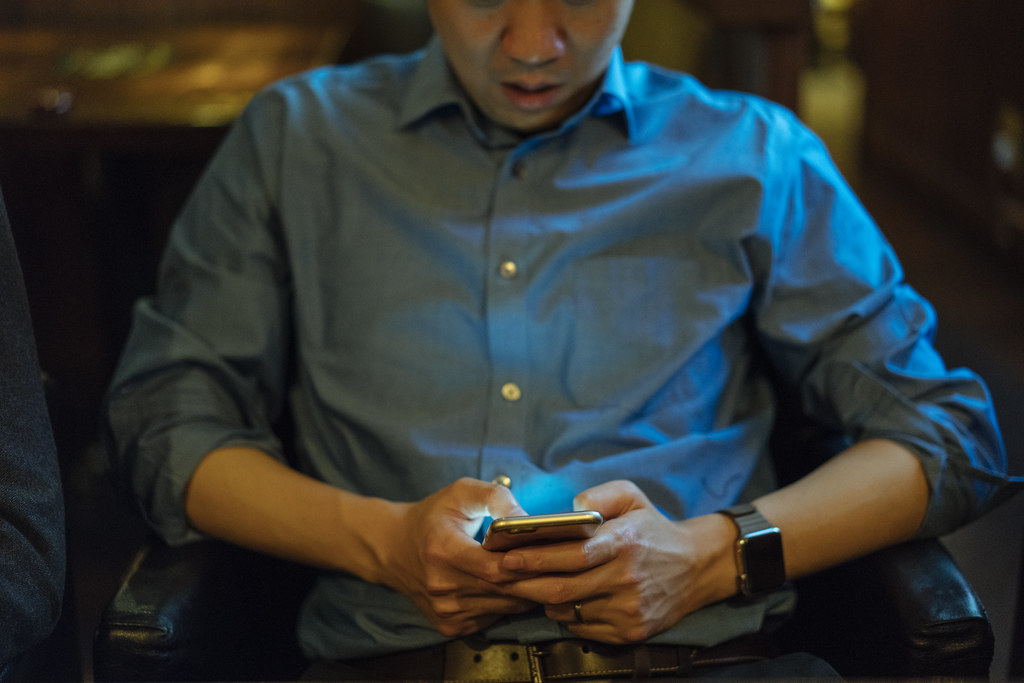
The selfie stick arrives in 2014. The Apple Watch in 2015. EarPods on the Tube, white wires still visible. The Great Wall of China selfie-stick conga. The Millennium Bridge at midnight, three hooded figures with extended phones-on-poles photographing the Thames. The album is, accidentally, a designer's ethnography of mobile interaction history. It would be easy to teach a class out of it.
From phone to person
What changed across these years is the centre of the photograph. The early frames are all about the phone (the keypad, the antenna, the message, the screen displayed). The late frames are almost all about the person (the slope of a back at a Tube ticket machine, the small still pose at the centre of Piccadilly Circus while pedestrians stream past, the in-bed glow on a face below the windowsill).
The postures became consistent across cultures faster than I'd expected. The head-down two-handed thumb-cradle is the dominant pose in maybe forty per cent of the photographs, in London and Tokyo and Buenos Aires and Oslo equally. The "freeze on the pavement" gesture, where a phone-user comes to a complete stop in the middle of a flow of pedestrians without warning, is now visible in cities where it would have been startling in 2008. There's a Piccadilly Circus dusk frame from October 2015, a young woman frozen on the kerb with buses streaming past behind her, that I think of as the still life of the project. Everything around her is moving and she is somewhere else.
The continuation
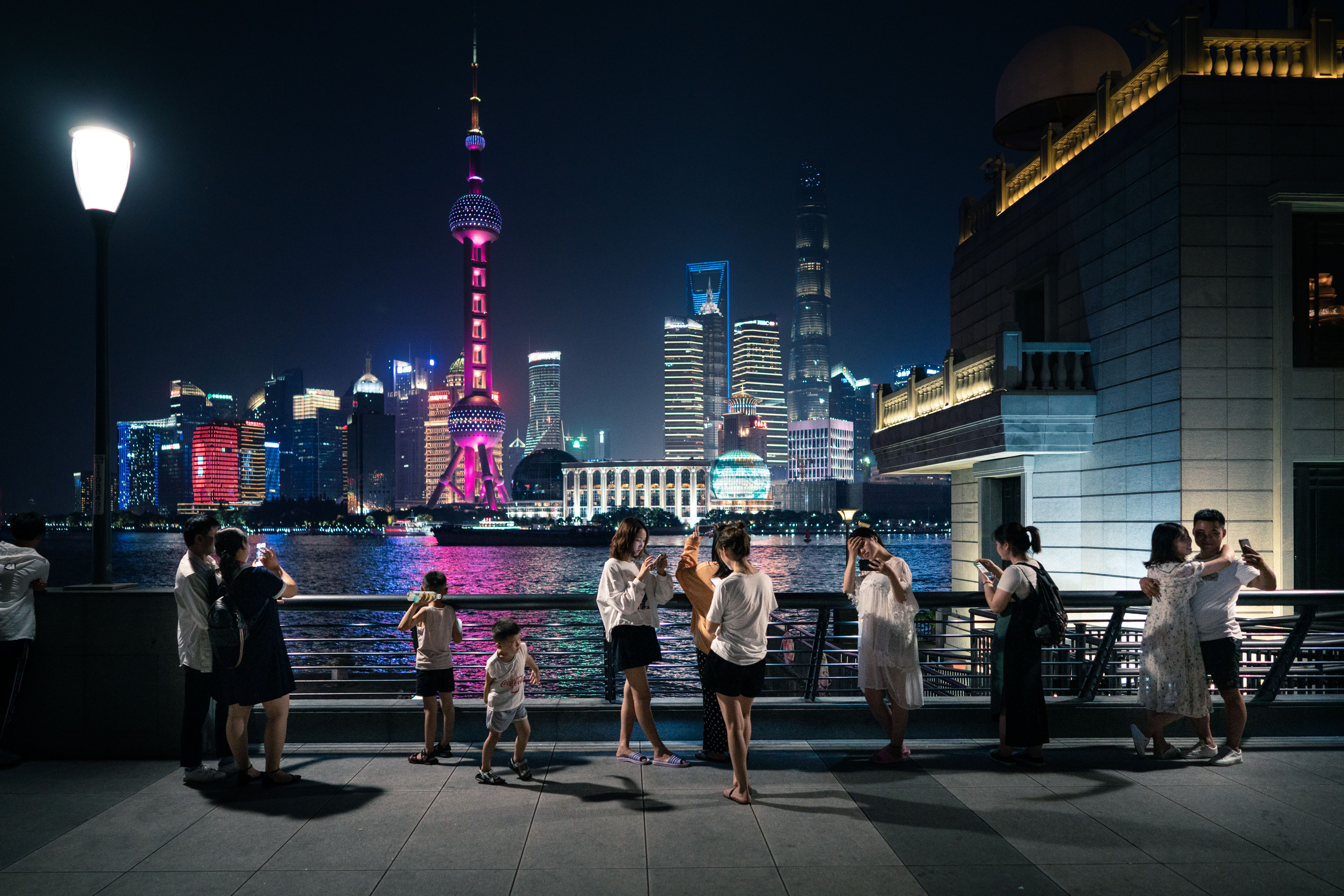
The album as published on Flickr trails off in late 2015. The titles toward the end are tagged "18.15, London" and "23.10, London" — the moment the project quietly geo-tags itself, as if by then the phone-user has become so generic that the only way to keep the photographs anchored to a real place is to put the city in the title. Around then I more or less stopped uploading. The body of work continued on disk, where it still continues. The Shanghai Bund frame above is from 2018, the people-photographing-televisions-with-their-phones frame on the Photography page is from a gallery in Tokyo, the woman on the DLR with the O2 dome through the window behind her is from London 2017. In 2024 I made Blueface, a video on the same subject. The interest is still there.
The thing that's different about this project from the louder "look at these zombies" genre of phones-on-the-street photography is that I don't find the subjects ridiculous. The people photographed are absorbed, busy, sometimes happy, sometimes the kind of quietly sad that ordinary humans in transit are. The phones are not the antagonists. They're part of the inventory.
What the album records, I think, is a window of about ten years between 2005 and 2015 when phones were still visibly new in cities. You could see the shapes of behaviours people were trying. The shared-earbud gesture. The mobile-TV antenna pressed against the Korean coach window. The walkie-talkie hold. The Apple Watch glance. After 2015 the phone became normal: everyone had one, everyone held it the same way, the gestures stopped being interesting because they were universal. The album thins out. Then in 2018 in Shanghai, twelve people line up against a railing all photographing the same city skyline with the same gesture, and the project briefly has new things to say again.
The early phone-as-thing photographs in the Touch project are this album's research-context cousins. The full set is at flickr.com/photos/timo/albums/72157632138168984.