Spatial memory at Design Engaged 2004
Eight thousand photographs over five months, mapped against time of day. Holidays show up as three horizontal clusters near the top. Late-night parties and early-morning flights scatter along the edges. Midnight sun is there too, a long band of photography where photography shouldn’t normally happen. Your own life as a scatter plot.
Presentation notes from Design Engaged 2004 in Amsterdam, November 2004. The slides are here as a PDF. Two related strands: the Time that land forgot project with Even Westvang, and the research on marking in urban public space. Thanks to Dan Hill, Adam Greenfield, Matt Jones, Molly Steenson and Fabio Sergio, the conference highlight of the year.
1. Time that land forgot
- A project in collaboration with Even Westvang
- Made in 10 days at the Icelandic locative media workshop, summer 2004
- Intended to make photo archives and GPS trails more useful and expressive
- Looked at patterns in my photography: five months, 8000 photos, visualised by date and time of day. A fantastic resource for me, late-night parties, early-morning flights, holidays, and the effect of midnight sun are all visible
- Now looking to make it useful as part of a more pragmatic interface, to try approaches less about the abstracted visualisation

Links:
2. Marking in urban public space
I’ve also been mapping stickering, stencilling and flyposting, walking around with camera and GPS and photographing examples of marking (not painted graffiti).
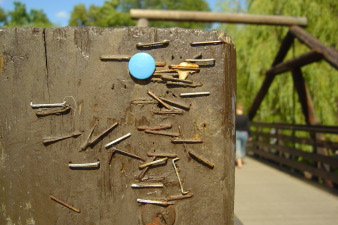
This research looks at the marking of public space by investigating the physical annotation of the city: stickering, stencilling, tagging, flyposting. It attempts to find patterns in that marking practice across visibility, techniques, process, location, content and audience. It proposes ways in which this marking could be a layer between the physical city and digital spatial annotation.
Some attributes of sticker design
- Visibility: contrast, monochromatic, patterns, bold shapes, repetition
- Patina: history, time, decay, degradation, relevance, filtering, social effects
- Physicality: residue of physical objects, interesting because these could easily contain digital information
- Adaptation and layout: layout is usually respectful, innovative use of DTP and photocopiers, adaptive use of sticker patina to make new messages on top of old
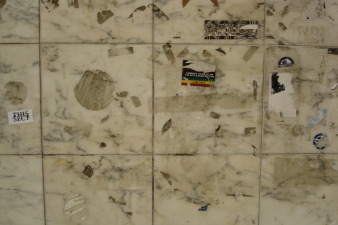
Layers of information build on top of each other. As with graffiti, stickers show their age through fading and patina. Flyposters become unstuck, torn, covered in fresh material. Viewed from a distance the patina is evident, new work tends to respect old, and even commercial flyposting respects existing graffiti work.
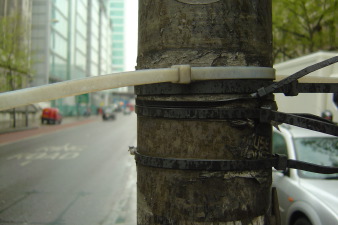
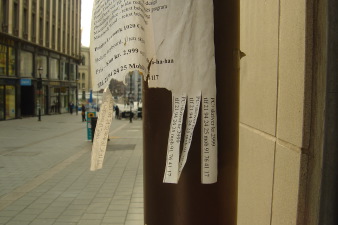
Techniques vary, zip-ties through cardboard around lampposts for large posters, hand-written notes stapled to trees, short-run printed stickers. One of the most interactive techniques is the poster offering strips of tear-off information, widely used even in remote areas.
Initial findings: stickers don’t relate to local space. They are less about specific locations than about finding popular locations, ‘cool neighbourhoods’, ensuring repeat exposure. This is the opposite of what I expected, and perhaps sheds some light on the current success or failure of spatial annotation projects.
The urban environment can act as an interface to information, an interaction layer for functionality, using our spatial and navigational senses to reach local and situated information.
There is concern that a dense spatially annotated city might overload us with information. What about filtering and fore-grounding of relevant, important information? Given that current technologies have very short ranges (10–30mm), we might use our existing spatial skills to navigate overlapping information. We could shift some of the burden of information retrieval from information architecture to physical space.
I closed by showing this animation by Kriss Salmanis, a young Latvian artist. A re-mediation of urban space through stencilling, animation and photography. (“Un ar reizi naks tas bridis” roughly translates as “And in time the moment will come”.)