Public markup
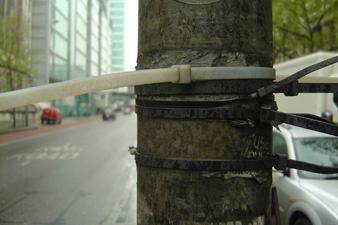
This research looks at the marking of public space by investigating the physical annotation of the city: stickering, graffiti and billboards. It tries to find patterns in the practice by looking at visibility, techniques, process, location, content and audience. It proposes ways in which this marking can be used as a layer between the physical city and digital spatial annotation.
I have been carrying a camera through Oslo, London, Reykjavik, Tallinn, the small towns up the Norwegian coast, and a few days in Split, photographing the surfaces where people have written. I posted a selection of thirty-five frames as a Flickr set, Spatial memory, and what follows is the longer text and research the original post promised.
What I'm photographing
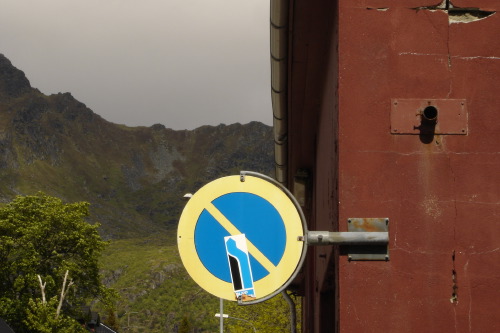
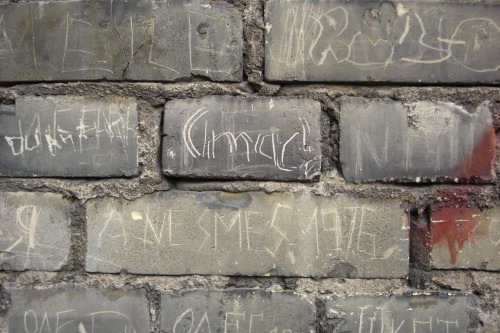
The photographs are not of the marks alone but of the locations that attract them. A lamppost outside a tube station. A waist-height span of brickwork beside a bus stop. The metal trunking on a phone-junction box. The flat, blank back of a road sign. Some surfaces in a city are recognised by everyone as marking surfaces, and they are dense; the surface a metre away may be untouched. The interest of the photographs, when I lay them out, is in the patterns of where rather than the content of what.
The album is titled Spatial memory on Flickr. The phrase is what people are doing when they sticker a lamppost: they are leaving a mark in space that someone else, walking past, will read. The marker has gone home. The mark stays. It is exactly what the city's official signage does, with the difference that the official signage was authorised. Spatial memory is the unauthorised parallel.
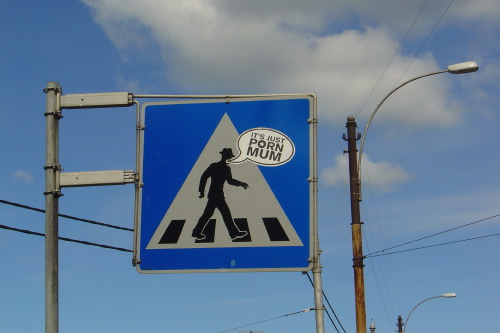
The frames so far. Six of them in Oslo. Eight in central and east London. Seven across Reykjavik in a single day. Two in Tallinn. Three up the Norwegian coast: Trondheim, Mo i Rana, Svolvær. One in Split, on the Adriatic. Each frame is captioned with nothing but the city and the date. A few of the more vivid pieces have the marker's own words for a title: It's just porn mum, Tellhim.no, Åsa do you remember me?, Block heads, Fuck. Where the writer named themselves, I have used the name they gave.
The argument: not invisible
The marking is interesting in itself. It is also interesting for what it suggests about the technologies I am working alongside. I have been spending the year reading and thinking about RFID, Bluetooth, and the first wave of barcode-and-cameraphone systems like SpotCode. The conventional framing of these technologies is that they will weave information into the city invisibly: an RFID tag the size of a grain of rice, a Bluetooth beacon you cannot see, a pattern of micro-dots embedded in the printing of a poster. The promise is seamlessness. The user does not need to know the tag is there.
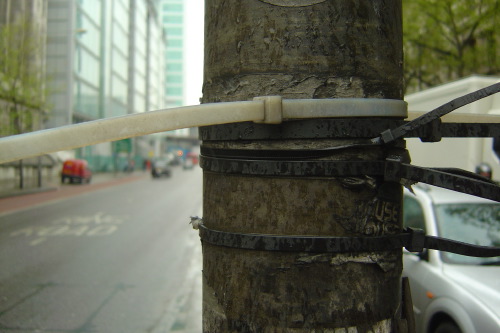
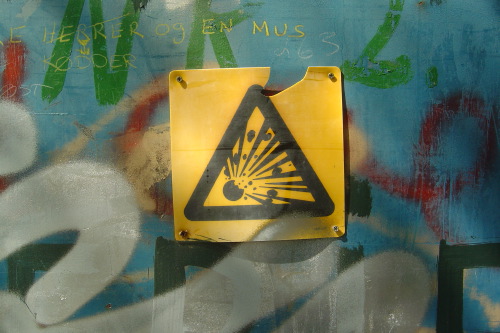
The flyposters, the cable ties on the lamppost, the stickers on the back of a road sign, all argue the opposite. People who want to mark public space do not, in practice, want their marks to be invisible. They want them to be visible: sometimes flagrantly, sometimes economically. A cluster of stickers on a pole has been carefully placed at eye level. A graffiti tag is sized to be read at walking pace from across a road. A flyposter has a tear-off strip at the bottom precisely because it expects to be acted upon by hand. The economy of public marking is an economy of attention, and attention is given to surfaces that announce themselves.
The lesson for what comes next is that the new short-range digital technologies, especially RFID, should be designed the same way. The Nokia RFID phone, recently released, gives a glimpse of an active, user-centred vision of RFID, one in which the user holds the reader and chooses what to swipe. This reverses the conventional idea of RFID as an invasive surveillance technology that reads tags without your knowledge. A short-range reader in your hand could shift some of the burden of information retrieval from information architecture to physical space. The design implications follow.
The flyposter with a tear-off contact strip is the model. RFID could replace the strip: a poster that you tap with your phone to take away the same information the strip used to carry, plus more. But for that to work, the tag must be marked. There must be a visible patch on the poster, a pictogram or graphic, that says swipe here. Two elements together: a physical poster to attract and inform, plus a visible patch where the digital layer is summoned. Not invisible.
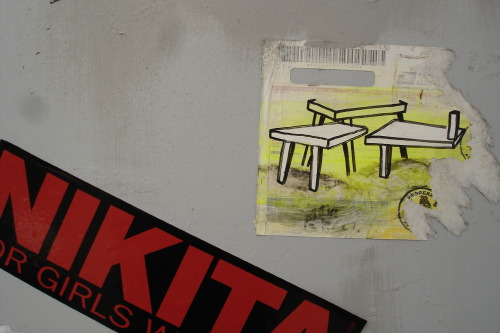
Two further locations to investigate, as research material rather than argument. First, the brass Stolpersteine in Berlin, set into the pavement outside the houses of those taken by the Nazis. They are small, deliberately walk-on, and only legible to the person who looks down. They are public marks designed to be found by attention rather than imposed on it. Second, the contemporary brit-art habit of marking pavements, lampposts and billboards with stickered art objects. Both are forms of marking that work because they are visible to those looking, and invisible to those who are not. The lesson holds.
What this might be a layer for
The proposal at the end of the lead. The marks already in the city (the stickers, the graffiti, the cable ties, the flyposters) could be read as a substrate, the thing that the digital spatial annotation layer should be modelled on rather than abstracted away from. A geo-located note left on a digital map is the same gesture as a sticker on a lamppost: the marker has gone home, the mark stays, the next person walking past reads it.
If the digital layer takes that seriously, it inherits the conventions: visible, accumulated, tactical, sometimes anonymous, sometimes named, often layered over earlier marks. It is read at walking pace. It belongs to the surface it is on. It can be erased. The right metaphor for the digital city is the well-stickered pole.
Postscript, written 8 May 2026. Twenty-two years after this was posted, several lines of work have grown out of the ideas in it. The post itself sat at this URL with only the first three sentences visible, and the longer text was filed in two outline documents that were never published. What's above this dateline is that longer text, lightly edited; what follows is a retrospective look at the descendants.
Marking in Public Space, CHI 2005. The first descendant is the most direct one: the research above was written up as a workshop paper for the Engaging the City session at CHI 2005 in Portland, Oregon, under the title Marking in Public Space. That paper carried the argument out of the blog post and into the academic record. It is the bridge between this 2004 photographic survey and the design-research projects that followed, and it pre-dates the November 2005 Graphic language for touch-based interactions at MobileHCI by six months.
Touch (2005–2009). The "not invisible" argument is the founding move of Touch, the design-research project at AHO that set out to make RFID and short-range wireless interaction graphically legible rather than seamlessly hidden. The November 2005 essay Graphic language for touch argues exactly the case sketched in the section above: the new digital surfaces need a visible vocabulary, and the existing AIGA pictogram tradition is the right place to look for one. The project ran for several years and produced the photographs of touch interfaces that I posted at Photos of touch-based interfaces.
Time that land forgot and the 2004 geo-referenced photography work. In parallel with this Public markup post, three months of GPS-tracked photography across Oslo and London had become Time that land forgot, exhibited as Photography and mapping from Afar and documented technically at Geo-referenced photography. That work treated photography itself as a way of marking space: every photograph leaving its own mark on a map, the GPS track standing in for the line a person draws by walking. It is the same gesture as the stickerer's, with the camera as the marking tool.
Ghost in the Field and Light Painting WiFi. Five years later, with Einar Sneve Martinussen and Jack Schulze, I set out to make wireless fields visible by walking an instrumented LED probe through them and photographing it in long exposure. Ghost in the Field rendered the read-volume of an RFID antenna in green light. Light Painting WiFi rendered an entire WiFi field as walls of standing blue light in an Oslo courtyard. Both projects are direct consequences of the argument above: if these short-range technologies are meant to be designed visibly, the first thing to do is render them so that anyone can see them. The rod-and-camera method is the technical answer to the design question this post posed.
Effects of the Network, 2006–2015. The same investigative habit, applied not to the design of new digital surfaces but to the recording of digital surfaces as they actually appeared in cities. Two hundred and six photographs across nine years, of NEW WIFI printouts taped to Paris café tills, hand-drawn QR codes on Brussels noticeboards, payment terminals, dot-matrix shop signs, antennas grafted onto roofs. The Flickr set is at Effects of the network. Public markup was the first iteration of the same eye, applied to physical marking. Effects of the Network is the version that watched the digital marking layer arrive in physical form.
Inhabiting Advertising, 2004–2015. The other long arm of the same investigation. While Effects of the Network tracks the new digital surfaces of the city, Inhabiting Advertising tracks the analogue surface: the pedestrian-crossing pictogram with a mohawk drawn on it in Ljubljana, the Stick no bills sign in Dubai covered in bills, the painted-facade programme in Tirana, the rural Italian fences made of mattresses. The Ljubljana seed in February 2005 is exactly nine months after this post, and is recognisably the same project under a different name.
The point of the retrospective is not to claim that the 2004 post predicted any of this. It is to say that the photographic habit of going looking for the marks people leave on public surfaces (a habit whose first systematic outing was the Spatial memory set on Flickr) turned out to be a way of finding the same question over and over for the next twenty years. What does it look like when people leave a mark in shared space? What surfaces attract the marks? What conventions emerge? How should the new technologies (RFID then, networked signage soon after, smartphone-mediated everything later) borrow from that vocabulary instead of trying to replace it?
I would still answer those questions the same way the post above does. Not invisible.