The address book desk
A grid of RFID tags stuck to the underside of the desk, and a mirror grid of post-it notes on the top. Hand-written on each post-it: a contact name, an SMS I want to send, a URL I want to load. Touch the phone to the paper, and the phone calls the contact, sends the SMS, or opens the URL. A phone-book, a to-do list and a temporary diary in one, with tea stains.
An early Touch project prototype from December 2005, using the Nokia Service Discovery application on a prototype 3220 NFC shell. A way of thinking through making, done at the desk in Oslo.
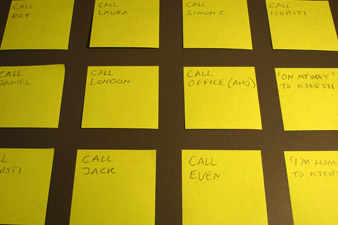
Initial ideas were to spraypaint or silkscreen some of the touch icons onto the desk surface, and I may well do that at some point. But for quick prototyping it made sense to use address labels or post-it notes that can be stuck, repositioned and layered with hand-written notes.
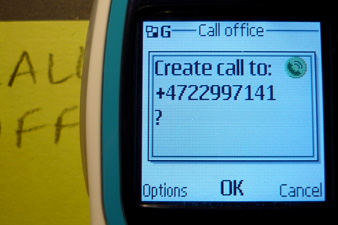
In many ways the desk is proving more inconvenient than the small screen, particularly with the occasionally unreliable firmware on this prototype cover, so I can’t speak for the production version. It has surfaced a few issues worth noting.
First, the importance of implicit habits. Initially it took real effort to think about using the table as an interface. I would reach for the phone and press names to make a call, instead of placing the phone on the desk. For some functions, sending an SMS, it has become habitual.
SMSes have become more like ‘pings’ when very little effort is needed to send them. At the same time they’re more physically tangible: I rest the phone in a position on the desk and wait for it to complete the action. The most useful functions have been “I’m here” or “I’m leaving” messages to close friends.
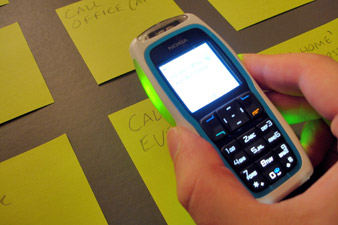
The ‘negative space’ where the phone rests without any action deserves thought. This space has potential to be used for context information, a corner of the table could make the phone silent, another corner could change my presence online. Jan Chipchase’s ideas around centres of gravity and points of reflection are directly relevant, these are the points that could most directly map to behaviour. I’m thinking about other objects and spaces that might be appropriate, and about the idea of thoughtless acts.
If this were a space without wireless internet, I could imagine it working well for URLs, quick access to Google searches, local services, number lookups, usually tricky on a small screen. The traditional Norwegian hytte [PDF], with no signal, would be a good context to test it in.
The process also raised a larger issue, the move towards tangible or physical information implies a move towards the social. As I arranged my address book and associated functions on the desk, I realised maybe these things shouldn’t be explicit, visible, social objects. The arrangement of people on the grid makes personal sense; the placement is a personal preference that maps to frequency and type of contact. But how does it appear to others when the pattern is exposed? Will people be offended by my layout? What if I don’t include a rarely called contact? Are there numbers I want to keep secret, hidden behind acronyms in the Names menu?
It will be interesting to see how this plays out and changes over time, particularly in the reaction of others. I’ll post more about the use of NFC in other personal contexts in the near future.
The making of…
The desk is made from 20mm birch ply, surfaced in Linoleum. I stuck a single RFID tag to the underside in the place that felt most natural. From that point I worked out a 10cm grid, stuck the RFIDs in the grid, and worked out the same grid on top. If I were to rebuild the desk with this project in mind, the tags should be layered close to the surface, between the ply and the Linoleum, slightly more responsive to touch, with a larger read/write distance.
Rewriteable 512-bit Philips MiFare UL stickers.
10cm grid of tags on the underside of the desk.
Blank post-it notes on the surface, with the same grid.